|
DAY 1 LIMA, CARAL, CHAVÍN: A
JOURNEY TO ANCIENT CITIES
 We
set off early by private vehicle from Lima, heading
north up the Pan-American Highway. After about 2 ½ hours,
our first major stop is Caral, once an important center
of the ancient cultures of the Norte Chico, the remains
of whose rock-and-earth stepped-pyramids lie scattered
across this desert region. Caral is the perfect place to
begin a tour of early Peruvian civilizations, since
archaeological evidence suggests that this extremely old
religious and residential complex was the cradle of
Andean civilization, perhaps the oldest urban center of
the Americas, establishing patterns of monumental
construction and religious worship that persisted for
millennia. Here around 2,600 BC, while the ancient
Egyptians were beginning to construct their pyramids,
early Peruvians established a less hierarchical society,
one based on marine resources, that apparently thrived
peacefully on trade and a now forgotten religion. We
set off early by private vehicle from Lima, heading
north up the Pan-American Highway. After about 2 ½ hours,
our first major stop is Caral, once an important center
of the ancient cultures of the Norte Chico, the remains
of whose rock-and-earth stepped-pyramids lie scattered
across this desert region. Caral is the perfect place to
begin a tour of early Peruvian civilizations, since
archaeological evidence suggests that this extremely old
religious and residential complex was the cradle of
Andean civilization, perhaps the oldest urban center of
the Americas, establishing patterns of monumental
construction and religious worship that persisted for
millennia. Here around 2,600 BC, while the ancient
Egyptians were beginning to construct their pyramids,
early Peruvians established a less hierarchical society,
one based on marine resources, that apparently thrived
peacefully on trade and a now forgotten religion.
We continue a short way north and then turn inland,
climbing into the Andes up a sinuous and dramatic paved
highway that takes us across a high pass and into the
famous Callejón de Huaylas, the valley of the Santa
river, and home to Peru´s highest snow-capped peaks.
Continuing east, we cross the next range, cresting the
Continental Divide, and descending into the Marañon/Amazon
river drainage on our way to Chavín de Huantar, the next
stop on our journey through Peru´s ancient past. We will
spend the next two nights at the selected accommodation.
(Box lunch)
DAY 2 CHAVÍN DE HUANTAR TO HUARAZ: FROM
HALLUCINOGENIC LABYRINTH TO HIGH CORDILLERAS
This morning we explore the intriguing remains of a
mysterious, powerful and astonishing civilization.
Chavín is known to archaeologists as the wellspring of
the "Early Horizon" period, dating from around 800 BC.
These were the first Andean people to spread their
cultural and religious influence far and wide, all the
way to the coast, and as distant as about 300Km/200
miles south of where Lima stands today. Their center
here at Chavín de Huantar straddled trans-Andean trade
routes, and drew pilgrims to a great temple, where
esoteric rituals were practiced under the influence of
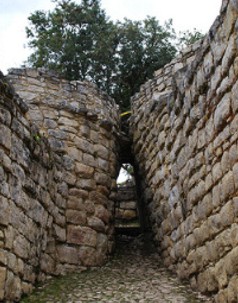
powerful hallucinogens. Here we see the subterranean
labyrinth which once boomed with the sound of water
rushing through hidden channels, and where a great stela
(the Lanzón) carved with ferocious mythical creatures
and mysterious symbols still stands in its central
chamber.
After lunch we return to the Callejón de Huaylas and
head north to Huaráz, at the foot of the Cordillera
Blanca, in the shadow of mighty Huascarán, Peru´s
highest mountain. We overnight in Huaraz. (B, L)
DAY 3 HUARÁZ, SECHÍN, TRUJILLO: DESCENT TO SECHÍN
ALTO AND THE SOURCES OF CHAVÍN, AND ON TO A SPANISH
COLONIAL CITY
We take another scenic plunge from Andes to Pacific
coast, and reach the site of Sechín Alto, the site of a
coastal civilization which pre-dated Chavín, and was
probably its cultural ancestor. Here an early Peruvian
civilization built a vast enclosure ringed with great
monoliths carved with gruesome scenes of battle,
mutilation and death. Scholars argue about whether these
were literal representations, or symbolic depictions of
these people´s ritual lives, but most agree that the
people of Sechín Alto were the predecessors of the
highland Chavín culture.
Sechín Bajo, an early part of this site dating from a
previous period -- perhaps as far back as 3,500 BC --
vies with Caral for the title of "first urban settlement
of the Americas".
After lunch we continue northward up the Pan-American
highway to Trujillo. This city, founded in 1534 on the
orders of Francisco Pizarro, maintains a colonial
atmosphere, with its spacious main square, and marvelous
colonial-period adobe buildings in the coastal colonial
style, featuring huge barred windows and massive wooden
doorways. Tomorrow we will get a close-up look at its
fine colonial architecture.
We will spend the next two nights at the selected
accommodation, a majestic hotel in the heart of
Trujillo´s historic center. (B, Box lunch)
DAY 4 TRUJILLO: THE COLONIAL CITY, THE GREAT ADOBE
PYRAMIDS OF HUACA DE LA LUNA AND HUACA DEL SOL, THE
PICTURESQUE BEACH RESORT OF HUANCHACO, AND THE PRE-INCA
CITY OF CHAN CHAN.
We begin a full day of touring and exploration around
this fascinating area. Touring the historic center of
Trujillo, a city whose heart still pulses with colonial
splendor, we visit the immense main square and the
spacious mansions built by Spanish and Creole gentry
during the 17th and 18th centuries.
After our city visit we drive a short way from Trujillo,
to visit the Huaca de la Luna, and the Huaca del Sol,
two huge flat-topped pyramids built by the Moche culture
between 0 and 600A.D. The Huaca de la Luna is an
extraordinary demonstration of what patient long-term
archaeology can achieve. Here, at a site that has been
well known and frequently looted for centuries,
excavations have revealed layer upon layer of ancient
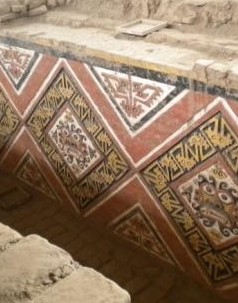
construction, uncovering wall after wall of colorful
friezes that were intentionally buried by the Moche, and
had not seen the light of day for one-and-a-half
thousand years. Bloodthirsty fanged deities and exotic
gods in the form of spiders, snakes felines, octopi and
other marine creatures rub shoulders with lines of
dancers, warriors and naked prisoners, and scenes of
ritual combat. One wall is covered with such a multitude
of mystifying symbols that it has been labeled simply "The
Complicated Theme" -- until some future archaeologist
can offer a plausible explanation of them. A site museum
to display material unearthed here is under construction,
and when opened it will be part of this visit.
We continue on to the nearby beach resort of Huanchaco,
where we have a chance to try the superb seafood of
Trujillo at a restaurant overlooking the Pacific Ocean.
Here fishermen still paddle out to sea, kneeling on
caballitos de totora -- little one-man reed rafts which
have been used for millennia to collect the abundant
bounty of the Pacific Ocean.
After lunch we return to Trujillo, stopping at the great
Chimú center of Chan Chan, the largest adobe city ever
built. It was in fact an elite settlement, a series of
nine enormous palaces belonging to successive rulers of
the Chimú realm. At its height the population here may
have reached 50,000 people. Many of them were artists
and craftspeople, who made the sumptuous goldwork,
textiles and pottery for which the Chimú were famous. At
the Tschudi palace enclosure we enter a labyrinthine
series of courtyards lined with clay friezes of fish and
ocean birds, and walled in places with an open meshwork
adobe building style believed to represent fishing nets.
We visit inner patios, residences, administrative
buildings, temples, platforms and storehouses, and a
huge reservoir where "sunken gardens" may have produced
specialized crops for the Chimu nobility.
We overnight in Trujillo. (B, L)
DAY 5 TRUJILLO TO CHICLAYO: THE MOCHE TEMPLE OF EL
BRUJO, PERUVIAN PASO HORSES, AND AN ELEGANT NORTH-COAST
LUNCH.
We set off early, heading north by road up the
Pan-American highway and into the adjacent Chicama river
valley, then making a short detour to the Pacific shore
to visit the archaeological site of El Brujo. This site,
featured in National Geographic magazine after the
sensational discovery here of the mummy of a tattooed
priestess, buried with a variety of ceremonial and
military accoutrements. An extraordinary array of
multicolored murals dating from seven or more phases of
construction depicts both scenes from the daily lives of
the Moche, and gory rituals of sacrifice.
Continuing northward, we make a stop at a hacienda in
Paiján to enjoy a delicious lunch, along with a colorful
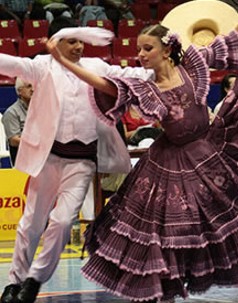
display of the skilled horsemanship of local Peruvian
paso horses and their riders, who combine their art with
the dance and music of the northern marinera. This is an
optional activity (cost not included), which we highly
recommend.
We reach Chiclayo in the afternoon, with time to relax,
and perhaps enjoy the pool or soak up the atmosphere of
this bustling tropical city. (B, L)
DAY 6 CHICLAYO, THEN LIMA: THE “CRACKED PYRAMID”,
TÚCUME, AND THE ROYAL TOMBS OF SIPÁN.
In the morning we set off for the mud-brick pyramid that
made world headlines in 1987 with one of the most
sensational finds of recent archaeology. Known as the
Huaca Rajada -- the "Cracked Pyramid", because of the
deep gulley’s weathered into its flanks -- this eroded
adobe platform yielded fabulous ancient treasures from a
series of deeply buried tombs of the pre-Inca Moche
culture, who lived in the valleys of Peru's north coast
1,500 years ago. To get there we drive east up the broad,
flat Reque valley past fields of sugarcane studded with
varicolored pastel foothills of the great Andean chain,
then arriving at the modern village of Sipán. Here we
see the tombs themselves, with superb reconstructions of
the burials of priests and chieftains, together with
their sacrificed guards and companions.
A highly informative site museum tells the story of this
extraordinary civilization, who created some of the
finest pottery, jewelry and gold working of the Americas
-- while also staging macabre costumed rituals of combat,
sacrifice and propitiation as they sought to mediate a
never ending struggle between the forces of Order and
Chaos.
We continue on to Lambayeque, where we visit the Royal
Tombs of Sipán Museum. This modern building,
representing the style of a Moche pyramid, was built to
house the stunning and priceless objects unearthed at
Sipán. (A single looted object from the tombs was
intercepted at an auction in the U.S. -- carrying a
reserve price of $1.6 million!)
Here we see the incredible array of precious symbols and
images, stones and shell necklaces, ear-plugs and
headdresses that were worn and displayed at Moche
ceremonies, and also learn what is known of their
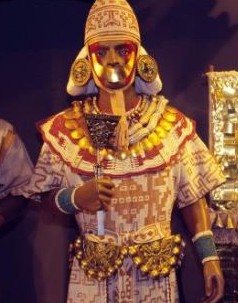
meaning. This astonishing visit ends at an "animated
waxworks" exhibit of the lords and retinue of the Moche
court, allowing us to glimpse and imagine the world of
an unfamiliar but dazzling civilization that thrived
here at a time when Europe was sliding into the Dark
Ages after the fall of the Roman Empire.
After these sensational experiences we return to
Chiclayo for a delicious lunch of Peru's northern-style
cuisine at a top local restaurant. We then drive onward
to an oasis of calm at Tucumé, today's final destination.
Here we see the chronological sequence that followed the
fall of the Moche, at a site where their descendants,
the Sicán culture, continued to amass millions of adobe
bricks for the building of mighty pyramids -- including
the longest of its kind, at more than 700m -- but were
now influenced by highland tribes, and began to abandon
their old ways. The history of this scenic site --
extensively investigated by the famed Norwegian explorer
Thor Heyerdahl -- leads us all the way to the Incas, who
conquered the region not long before they, in turn, were
conquered by the Spanish. We can climb to a viewing
platform with superb views of the surrounding pyramids
and the dry woodland habitat of the Leche valley. We can
also visit the small, intimate and low-tech site museum,
to enjoy the excellent collection of excavated objects,
dioramas of daily life, and models of the pyramids.
We say farewell to the warm, dry valleys of Northern
Peru and set off for the airport in the late afternoon
for our evening flight to Lima (Airfare not included).
(B, L)
*IMPORTANT:
1-Please note that on Mondays the Museum of Royal Tombs
of Sipan and the Museum of Sican are closed.
Instead we may offer the Bruning Museum.
2-The city tour in Trujillo suggested program Monday
through Friday between 9 am and 2 pm.
Outside these hours that may be widescreen or
alternative views.
3-Just like to note that on Mondays the Cajamarca city
tour is not operational. Only can be offer as panoramic. |