|
 DAY 1 LIMA PICK UP DAY 1 LIMA PICK UP
Pick up upon arrival at Lima’s airport and
transportation to the hotel. Overnight (No meals)
DAY 2 LIMA TO CHICLAYO: THE "CRACKED PYRAMID", TÚCUME,
AND THE ROYAL TOMBS OF SIPÁN.
We take an early morning flight from Peru's capital to
the northern city of Chiclayo( Airfare Not Included),
and after some rest time we set off for the mud-brick
pyramid that made world headlines in 1987 with one of
the most sensational finds of recent archaeology. Known
as the Huaca Rajada -- the "Cracked Pyramid", because of
the deep gulleys weathered into its flanks -- this
eroded adobe platform yielded fabulous ancient treasures
from a series of deeply buried tombs of the pre-Inca
Moche culture, who lived in the valleys of Peru's north
coast 1,500 years ago. To get there we drive east up the
broad, flat Reque valley past fields of sugarcane
studded with varicolored pastel foothills of the great
Andean chain, then arriving at the modern village of
Sipán. Here we see the tombs themselves, with superb
reconstructions of the burials of priests and chieftains,
together with their sacrificed guards and companions.
A highly informative site museum tells the story of this
extraordinary civilization, who created some of the
finest pottery, jewelry and gold working of the Americas
-- while also staging macabre costumed rituals of combat,
sacrifice and propitiation as they sought to mediate a
never ending struggle between the forces of Order and
Chaos.
We return to Chiclayo for a delicious lunch of Peru's
northern-style cuisine, and then continue on to
Lambayeque, where we visit the Royal Tombs of Sipán
Museum. This modern building, representing the style of
a Moche pyramid, was built to house the stunning and
priceless objects unearthed at Sipán. (A single looted
object from the tombs was intercepted at an auction in
the U.S. -- carrying a reserve price of $1.6 million!)
Here we see the incredible array of precious symbols and
images, stones and shell necklaces, ear-plugs and
headdresses that were worn and displayed at Moche
ceremonies, and also learn what is known of their
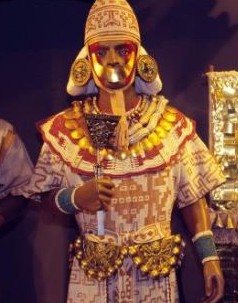
meaning. This astonishing visit ends at an "animated
waxworks" exhibit of the lords and retinue of the Moche
court, allowing us to glimpse and imagine the world of
an unfamiliar but dazzling civilization that thrived
here at a time when Europe was sliding into the Dark
Ages after the fall of the Roman Empire.
After these sensational experiences we drive to an oasis
of calm at Tucumé, today's final destination. Here we
see the chronological sequence that followed the fall of
the Moche, at a site where their descendants, the Sicán
culture, continued to amass millions of adobe bricks for
the building of mighty pyramids (including the longest
of its kind in the world, at more than 700m/2,300ft) but
were now influenced by highland tribes, and began to
abandon their old ways. The history of this scenic site
-- extensively investigated by the famed Norwegian
explorer Thor Heyerdahl -- leads us all the way to the
Incas, who conquered the region not long before they, in
turn, were conquered by the Spanish. We can climb to a
viewing platform with superb views of the surrounding
pyramids and the dry woodland habitat of the Leche
valley. We can also visit the small, intimate and low-tech
site museum, to enjoy the excellent collection of
excavated objects, dioramas of daily life, and models of
the pyramids.
We return to Chiclayo for an overnight stay. (Box lunch,
D)
DAY 3 CHICLAYO TO CHACHAPOYAS: ACROSS THE ANDES TO
THE AMAZON
We drive northward from Chiclayo across Peru's coastal
plains, following the Pan-American Highway, then turn
east onto the Trans-Andean route, ascending gently
through regions of dry forest interspersed with
irrigated farmland. Our road loops towards the lowest
pass of the Peruvian Andes, at 2,135m/7,000 ft, where we
cross the continental divide and enter the Upper Amazon
basin. Following the valley of the Huancabamba/Chamaya
river system we pass broad ribbons of bright green rice
terracing, forming a striking contrast with the cactus
and dense thorn-scrub vegetation of the mountainsides.
Lower downstream we pass the massive dam and intake of
the Olmos irrigation project, ultimately destined to
divert much of this water through a 23Km/14.2 mile long
tunnel to the Pacific slope of the Andes.
We reach the bridge over the Marañon, one of the great
tributaries of the Upper Amazon, which was formerly
believed to be the source of that mighty river. Here we
enter the Peruvian department of Amazonas, former home
of a mysterious and powerful civilization, the
Chachapoyas, whose remnants we will explore during this
journey.
We follow the Utcubamba River, the main artery of the
Chachapoyan heartland, first ascending a dramatic canyon
then winding up the mountainous valley which leads us to
El Chillo, our hotel at the foot of the high road to the
mountaintop site of Kuelap, tomorrow's destination. (B,
Box Lunch, D)
DAY 4 CHACHAPOYAS: KUELAP, THE GREAT WALLED CITY OF
NORTHERN PERU
We spend a full day visiting this huge and mysterious
site, beginning with a drive through places whose names
: Choctamal, Longuita, and Kuelap itself , evoke a lost
language and a vanished ancient people who spoke it, the
Chachapoyans. We don't know what they called themselves,
but the Incas who finally conquered these fierce
warriors knew them by their Quechua soubriquet,
Chachaphuyu “Cloud People” after the cloud-draped region
where they lived.
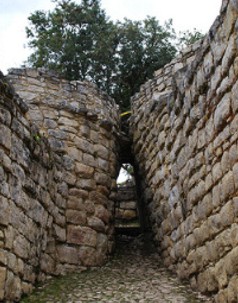
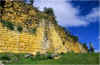
Kuelap's existence was first reported in 1843. For years
it was believed to have been a Chachapoyan fortress, and
when we first catch sight of it from the fossil-encrusted
limestone footpath that leads there it is hard to
believe it was not. The massive walls soar to a height
of 19m/62ft and its few entranceways are narrow and
tapering, ideal for defense. Yet the archaeological
evidence now suggests that this was principally a
religious and ceremonial site.
Chachapoyas was not a nation or an empire, but some sort
of federation of small states centered on numerous
settlements scattered across their mountainous territory.
The earliest settlement dates obtained here suggest that
its construction began around 500A.D. and, like the
Moche coastal pyramids, it was built in stages as a
series of platforms, one atop the other.
It is now a single enormous platform nearly 600m/2,000ft
long, stretched along a soaring ridgetop. Seen from
below, its vast, blank walls give no hint of the
complexity and extent of the buildings above. When we
reach its summit we find a maze of structures in a
variety of styles and sizes, some of them faced with
rhomboid friezes, some ruined and some well preserved.
Here we can try to imagine the lives of the Chachapoyan
elite and their servants who lived here, enjoying a
breathtaking view of forested Andean mountains and
valleys.
So distant and neglected was this region until recently
that little archaeological research has been done at
this important site, and our knowledge of it remains
vague. An adjacent site named La Mallca, larger though
less dramatic than Kuelap, has not been studied at all.
Even today, Kuelap's remoteness ensures that only a
handful of other visitors are there to share it with us.
We return to El Chillo for dinner. (B, Box Lunch, D)
DAY 5 CHACHAPOYAS TO LEIMEBAMBA: JOURNEY TO THE CLIFF
TOMBS OF REVASH, AND ON TO A TRADITIONAL ANDEAN TOWN
We follow the Utcubamba valley upstream, spotting herons
and perhaps an Andean torrent duck in the river as we
slowly ascend the valley. At the village of Santo Tomás
we turn off the main highway, crossing the river and
ascending a side valley where vivid scarlet poinsettias
the size of trees overhang the walls of typical
Chachapoyan farms, with verandas surrounded by wooden
columns, and topped with tile roofs. Soon we meet our
wranglers and the calm, sure-footed horses that will
carry us up the trail to Revash.
Throughout this journey we gaze up at huge cliffs that
loom ever closer. These limestone formations, laid down
in even layers over geological eons, tend to break away
in neat collapses, often leaving extensive overhangs and
protected ledges beneath them. In such places the
ancient Chachapoya built the tombs where they buried
their noble dead.
A gigantic fold in the cliffs, testifying to millennia
of unimaginable tectonic forces, lies ahead of us, and
at the top of the fold one such cave houses a group of
tombs, ruined structures still bearing their original
coat of red and white pigment. But they are far off, and
this is not yet Revash. Another hour brings us to a
viewpoint much closer to the cliffs, and here we see two
adjacent sets of caves, featuring cottage-sized
structures covered in still-bright mineral-oxide
paintwork. Some of them look like cottages, with gabled
roofs, others like flat-topped apartments. They are
adorned with red-on-white figures and geometrical
symbols -- a feline, llamas, circles, ovals -- and bas-relief
crosses and T-shapes, which perhaps once told the rank
and lineage of the tombs' occupants. They are silent,
empty, their contents long ago looted, their facades
still straining to tell a story whose meaning was lost
long ago.
Retracing our steps we continue our road journey to
Leimebamba, which we reach mid-afternoon. This
settlement was established by the Incas during their
conquest of the region, and continued as a colonial town
under the Spanish. It retains much of this antique charm
in its balconied houses with narrow streets where more
horses than cars are parked. We go a little further up
the highway and pull in to the spacious garden
environment of the Leimebamba Museum, where we settle in
to guest rooms specially provided for visitors. Then we
visit this delightful collection of extraordinary
artifacts recovered from another group of cliff tombs
discovered as recently as 1997 at the remote Laguna de
los Condores, high in the mountains east of the town.
The exhibits, cheerfully displayed in well-lit rooms,
offer a sample from the mass of artifacts recovered from
this amazing discovery. In 1997 a group of undiscovered
cliff tombs -- similar in style to those of Revash --
was spotted above the remote Laguna de los Condores by
local farmhands. Although they looted and damaged the
site, a mass of priceless objects and a trove of vital
information was rescued. We see gourds carved with
animal and geometrical symbols, an array of colorful
textiles, ceramics, carved wooden beakers and portrait
heads, and a selection of the dozens of quipus (Inca
knotted-string recording devices) recovered from the
site. A big picture window offers a view of the
temperature- and humidity-controlled temporary "mausoleum"
where more than two hundred salvaged mummies are kept.
Archaeologists are still uncertain as to how most of
this material came to be so startlingly well-preserved,
in tombs that during the rainy season were actually
behind a waterfall! But perhaps the most striking thing
about the tombs is that they contain burials from all
three periods of local history: the Chachapoya cultural
heyday, the post-Inca invasion period, and the post-Spanish
conquest. Archaeologists are continuing to study the
material, seeking to learn more about the Chachapoya and
their relationship with their Inca masters. The quipu
finds have been especially valuable to scholars seeking
to decode the Inca record keeping system.
After our museum tour we can visit the Kenticafé across
the street, for a cup of the best coffee in Chachapoyas,
where we may see dozens of the region's exotic
hummingbirds flitting among the strategically placed
feeders, perhaps including the dazzling and highly
endangered Marvelous Spatuletail. (B, Box Lunch, D)
DAY 6 LEIMEBAMBA TO CAJAMARCA: ACROSS THE MARAÑON
CANYON
This day offers us new perspectives on the multitude of
natural environments of the Peruvian Andes. We climb
through dairy country, where cattle graze in green
pastures studded with rock outcrops, dells and belts of
woodland. As we go higher this landscape gives way to a
high altitude puna region of smooth slopes densely
covered in a beige bunch-grass known as ichu. We cross a
high pass at 3,500m and begin a long traverse to a lower
pass, where we look down on the distant Marañon river,
which we crossed for the first time four days ago. A
long, winding descent brings us at last to a warm,
irrigated valley filled with mango trees, coconut palms,
papaya and banana plantations. Soon we reach Balsas, a
village at the bridge over the Marañon.
We cross the mighty river into the Department of
Cajamarca, and climb through an arid canyon environment
of tall cactus and gnarled trees. Eventually we reach
farmland again, rolling country of wheat, barley and oat
fields, and we begin to see adobe farmhouses. And we
spot farmers and their children wearing the
characteristic large, broad-brimmed Cajamarca straw hat.
We pause in the city of Celendín for lunch, and continue
on to our destination, the regional capital of
Cajamarca. We arrive late afternoon at the Cajamarca
suburb of Baños del Inca, where the spacious Laguna Seca
Hotel offers us a welcome rest and a room with its own
huge hot tub and unlimited piping-hot thermal spring
water.(B, L, D)
DAY 7 IN CAJAMARCA: COLONIAL SPAIN AND THE LAST DAYS
OF THE INCA EMPIRE.
Our hot springs hotel provides a wonderful and well-earned
finale of luxuriant relaxation, with delicious dining,
spa facilities, and a spacious private hot pool in every
room. The springs themselves are famous, the site of a
historic first encounter between the Inca emperor
Atahualpa and the Spaniards who, unknown to him, had
come to conquer his empire. The Inca was himself
enjoying a hot soak at the very moment of his victory
over rival armies in a long and bloody war of succession,
when a small contingent of mounted Spaniards rode out
from Cajamarca to visit him, and to arrange a fateful "unarmed"
meeting in the city square next day. The rest, as they
say, is history.
Today we drive into the city center, and up to the
hilltop now known as Colina Santa Apolonia. This was a
sacred mountain to the Cajamarca people who held sway in
this valley for nearly two thousand years, until the
Incas conquered them, and ancient rock carvings can
still be seen on its summit. Today we look out over the
modern city of some 250,000 inhabitants, spread out over
a valley at 2,700m/8,850ft surrounded by low mountains.
After viewing the lay of the land we descend the steps
into the old city center, which lies directly below us.
Spanish colonial houses line the streets here, and the
churches, such as San Francisco and Belén, wear facades
of intricate, fantastical baroque-mestizo stonework,
although all trace of the Inca halls from which
Francisco Pizarro and his conquistadors launched
history's most fateful and treacherous ambush have
disappeared. Nevertheless, we visit one Inca stone
building that still stands, its smoothly rounded stone
walls and perfectly fitted stones testifying to its
noble Inca origins. Local folklore holds that this was
the room which the Inca Atahualpa offered to fill once
with gold and twice with silver, in exchange for his
freedom. This forlorn monument is a suitable spot to
hear the story of Atahualpa's fabulous ransom and its
tragic denouement.
We visit the Museum in the old colonial hospital of the
Church of Belen, to get in touch with and see some fine
artifacts from an older culture -- known to us as the
Cajamarca -- who occupied this valley for some 2,000
years before finally succumbing to the Inca expansion.
After lunch at a fine local restaurant we pay a visit to
the nearby rock formation at Otuzco, where over
thousands of years the pre-Inca Cajamarca peoples left
hundreds of elaborate niches, or "windows", hewn into
bedrock, in which they buried their dead. We return in
time to make the most of the facilities at the hotel
before dinner. (B, L, D)
DAY 8 CAJAMARCA TO TRUJILLO: FROM MOUNTAIN CITY TO
COASTAL DESERT
We start out at 8am, aiming to reach Trujillo by mid-afternoon,
in order to visit some of the city highlights before
dinner. The condition of the first part of this road may
vary, so we adjust our departure time accordingly.
The route across the rolling mountain scenery of the
Cajamarca valley and dramatic descent through rugged
ravines to the coast offers another sample of Peru's
startling varieties of terrain and geography. We will
stop for an open air picnic lunch at a scenic spot
overlooking the great lake behind the Gallito Ciego dam.
If time allows we can combine this with a visit to the
nearby petroglyphs of Yonán. By early afternoon we meet
the Pan-American highway 120 Km. north of Trujillo, and
finish our journey on a major paved highway.
In Trujllo we have time to get our bearings in the city
center, with its spacious Main Square, and marvelous
colonial-period adobe buildings in the coastal colonial
style, featuring huge barred windows and massive wooden
doorways. We take time to see one of these -- the Casa
de la Emancipación, now a bank, but open to the public.
This is the former colonial mansion where rebellious
local citizens proclaimed independence from Spain, ahead
of the rest of Peru, in 1820. The colonial atmosphere
and decor have been faithfully preserved, and there is a
display model of old Trujillo, from a time when a
fortified wall protected the city from pirate raids (B,
Box lunch, D)
DAY 9 THE GREAT ADOBE PLATFORMS OF HUACA DE LA LUNA
AND HUACA DEL SOL, THE PICTURESQUE BEACH RESORT OF
HUANCHACO, AND THE PRE-INCA CITY OF CHAN CHAN.
In the morning we drive a short way from Trujillo, to
visit the Huaca de la Luna, and the Huaca del Sol, two
huge flat-topped pyramids built by the Moche culture
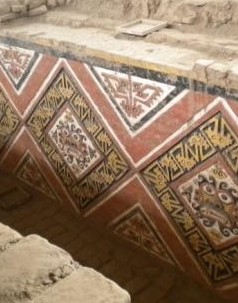
between 0 and 600A.D. The Huaca de la Luna is an
extraordinary demonstration of what patient long-term
archaeology can achieve. Here, at a site that has been
well known and frequently looted for centuries,
excavations have revealed layer upon layer of ancient
construction, uncovering wall after wall of colorful
friezes that were deliberately buried by the Moche, and
had not seen the light of day for one-and-a-half
thousand years. Bloodthirsty fanged deities and exotic
gods in the form of spiders, snakes felines, octopi and
other marine creatures rub shoulders with lines of
dancers, warriors and naked prisoners, and scenes of
ritual combat. One wall is covered with such a multitude
of mystifying symbols that it has been labeled simply "The
Complicated Theme" -- until some future genius can offer
a plausible explanation of them. A site museum to
display material unearthed here is under construction,
and when opened it will be part of this visit.
We make our way through Trujillo to the seashore,
stopping en route to see the Huaca del Dragón, a pyramid
built by the Chimú culture, a dynasty that assumed power
after the Moche in this part of Peru until they were
conquered by the Incas.
At the nearby beach resort of Huanchaco we have a chance
to try the superb seafood of Trujillo at a restaurant
overlooking the Pacific Ocean. Here fishermen still
paddle out to sea, kneeling on caballitos de totora --
one-man reed rafts which have been used for millennia to
collect the abundant bounty of the Pacific Ocean.
After lunch we visit the great Chimú center of Chan
Chan, the largest adobe city ever built. It was in fact
an elite settlement, a series of nine enormous palaces
belonging to successive rulers of the Chimú realm. At
its height the population here may have reached 50,000
people. Many of them were artists and craftspeople, who
made the sumptuous gold work, textiles and pottery for
which the Chimú were famous. At the Tschudi palace
enclosure we enter a labyrinthine series of courtyards
lined with clay friezes of fish and ocean birds, and
surrounded in places with open meshwork-style adobe
walls, believed to represent fishing nets. We visit
inner patios, residences, administrative buildings,
temples, platforms and storehouses, and a huge reservoir
where "sunken gardens" may have produced specialized
crops for the Chimu nobility.
We return to Trujillo in time for our evening flight to
Lima (Airfare not Included). Upon arrival transfer to
the hotel. Overnight(B,L)
DAY 10 TRANSFER OUT
Transfer to the airport where you'll take your
international flight and end of the services (B)
END OF THE SERVICES |